
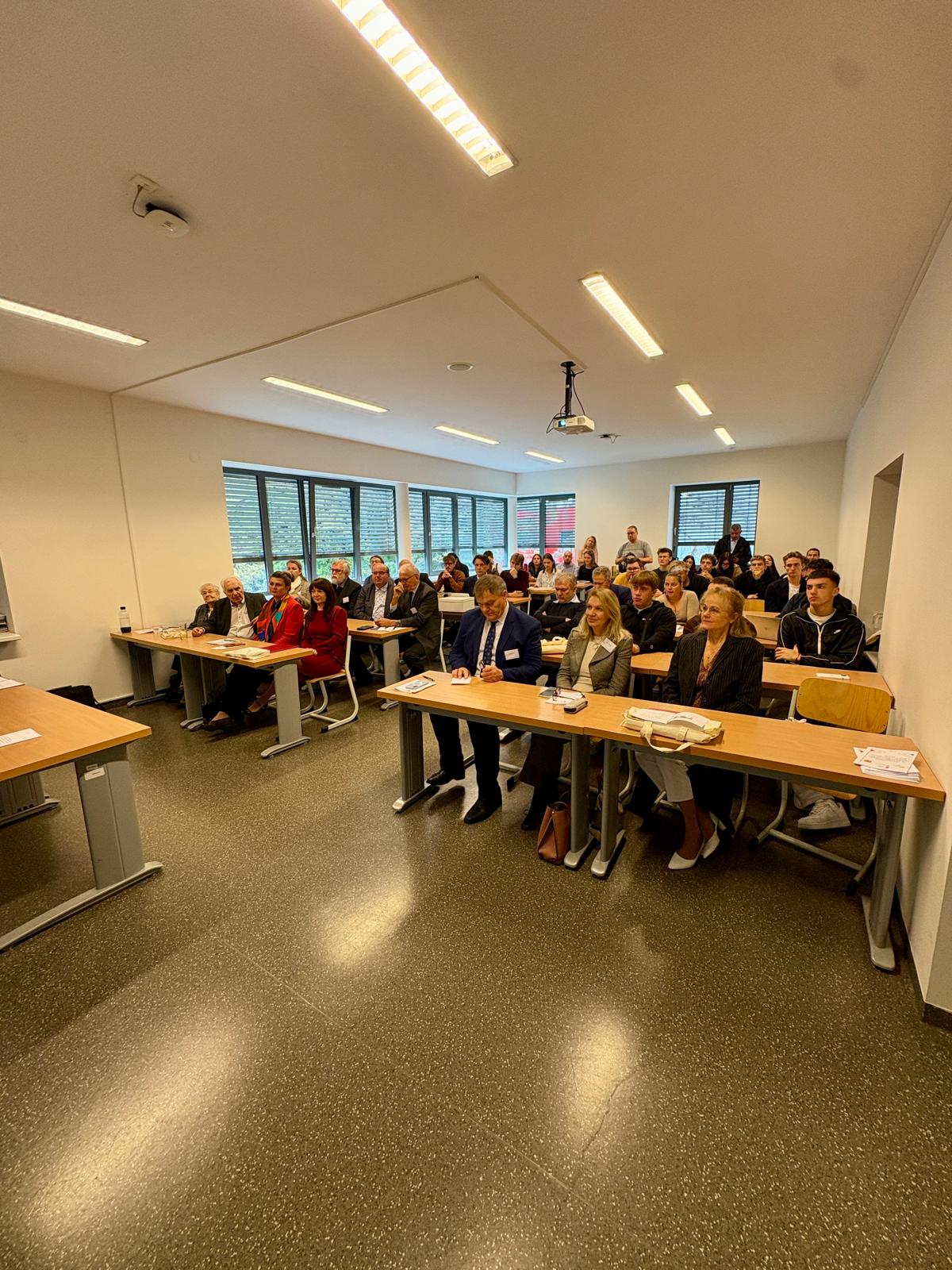
The representation of war in literature and the media is not merely a reminder of historical events, but also of the individual human fates that war has marked. It is also a way in which the experience of war is interpreted, conveyed and preserved in social memory. This was confirmed by the international scientific conference Re-presentation of Contemporary War Conflicts in the Media, Literature and Film of the V4 Countries with an Emphasis on the Czech-Slovak Area, held on 15 October 2026 at the Faculty of Central European Studies of Constantine the Philosopher University in Nitra.
The event was organised by the Institute of Central European Languages and Cultures of the FCES UKF in Nitra in cooperation with the Embassy of the Czech Republic in Bratislava, the Czech Centre in Bratislava and the Department of International Relations and Diplomacy of the Faculty of Political Science and International Relations of Matej Bel University in Banská Bystrica. The thematic focus of the conference was shaped by current social events and by the need for expert reflection on the causes and circumstances that precede war conflicts, as well as on the ways in which the experience of war is reflected in contemporary literary, media and film production. The event also followed up on previous editions of expert meetings, which take place thanks to the financial and moral support of Czech partners.
The importance of cooperation with the Embassy of the Czech Republic in Bratislava and Matej Bel University in Banská Bystrica was also highlighted in the opening address by doc. PhDr. Martina Pavlíková, PhD., MBA, Vice-Rector for International Relations of UKF in Nitra. Among other things, she recalled the prompt response of Czech diplomacy to the Hamas attacks on Israel of 7 October 2023. Her words were followed by the Ambassador of the Czech Republic in Bratislava, Rudolf Jindrák, who stressed the importance of mutual dialogue and the need for critical reflection on war conflicts and their consequences. In this context, he also appreciated the broad thematic scope of the conference, which made it possible to discuss various forms of the experience of war.
In this context, the mission of the Institute of Central European Languages and Cultures of the FCES UKF in Nitra takes on particular significance, as its academic orientation includes reflection on the historical, cultural and social processes shaping Central Europe. Through events of this kind, the institute seeks not only to open topical issues, but also to create space for the encounter of different experiences, opinions and interpretative perspectives.
The conference brought together representatives of the academic and wider professional community from Poland, the Czech Republic and Slovakia. The diversity of topics and interpretative approaches was reflected not only in the individual presentations, but also in the discussions at the end of the thematic blocks, which raised further questions and stimuli for thinking about the ways war and its consequences are depicted.
Using selected literary works, Tibor Žilka pointed to the courage and bravery of women at the end of the Second World War. He also addressed the contradiction between the liberating mission of the Red Army in the fight against Nazism and the violence its members committed against the civilian population of the liberated and occupied territories. He touched on the sexual violence committed against women, which represents one of the tragic and long-silenced aspects of the experience of war. In this context, he also recalled the tragedy of the Ukrainian town of Bucha, which has become one of the symbols of the brutality of the Russian armed forces towards the civilian population. Through literary examples, he thus opened not only the question of war as a denial of respect for human life and human dignity, but also the issue of the politically motivated silencing of historical experience. Under the communist regime, the literary depiction of violence committed by Soviet soldiers ran up against ideological restrictions and censorship, and especially in the Stalinist period, openly naming these facts could even lead to political reprisals.
Libor Pavera dealt with the issue of communication and its symbolic forms. Using the film Bent as an example, he showed how a person’s identity can be replaced by a sign or a colour. The sign seems to speak for the person who wears it, regardless of their personality, experience or attitudes. In this sense, it becomes a tool for categorising people and drawing boundaries between “us” and “them”, while a person’s individual identity is pushed into the background by their membership of a particular group.
Petr Komenda drew attention to the ability of poetry to capture the dramatic experience of the Russian-Ukrainian war, in particular the events connected with the siege of Mariupol. Through an analysis of the poem Pluk Azov (2026) by the Czech writer Radek Štěpánek, he pointed to the capacity of poetic language to convey the experience of war violence. The question of the linguistic and expressive means by which events and human experience can be captured in situations whose intensity exceeds the possibilities of ordinary narration came to the fore.
Peter Juščák, Chairman of the Association of Writers’ Organisations of Slovakia, presented the issue of deportations to Soviet labour camps. He focused on the circumstances and mechanisms of forced deportation, as well as on the inhuman conditions in which, figuratively speaking, the prisoners were left with only one thing – the right to work and the right to die. He also discussed the historical context of the individual deportations and the periods when those deported returned home, recalling one of the tragic chapters of post-war history.
University lecturer, film and television director and screenwriter Ján Sabol used the films Robinson & Crusoe, Svetloplachosť and Válečný zpravodaj to present various possibilities of depicting the experience of war on film – from allegorical representation to documentary capture of the immediate reality of armed conflict. By contrasting different filmmaking approaches, he also raised the question of the relationship between artistic stylisation and documentary testimony.
Alexej Mikulášek dealt with various territorial conflicts, against the background of which he examined the mechanisms of forming collective identities and the discursive construction of the opposition between “us” and “them”. Drawing on critical analysis of political discourse (CAPD), he pointed to the ways in which language, stereotypical notions and the selective interpretation of historical events contribute to creating and strengthening boundaries between communities.
University lecturer, director and screenwriter Marek Janičík focused on the film portrayal of the war in Ukraine in the work of Slovak director Pavol Pekarčík. Drawing also on a personal interview with the director, he described the specific features of his filmmaking approach to depicting the war, the experience of the civilian population and everyday life under threat.
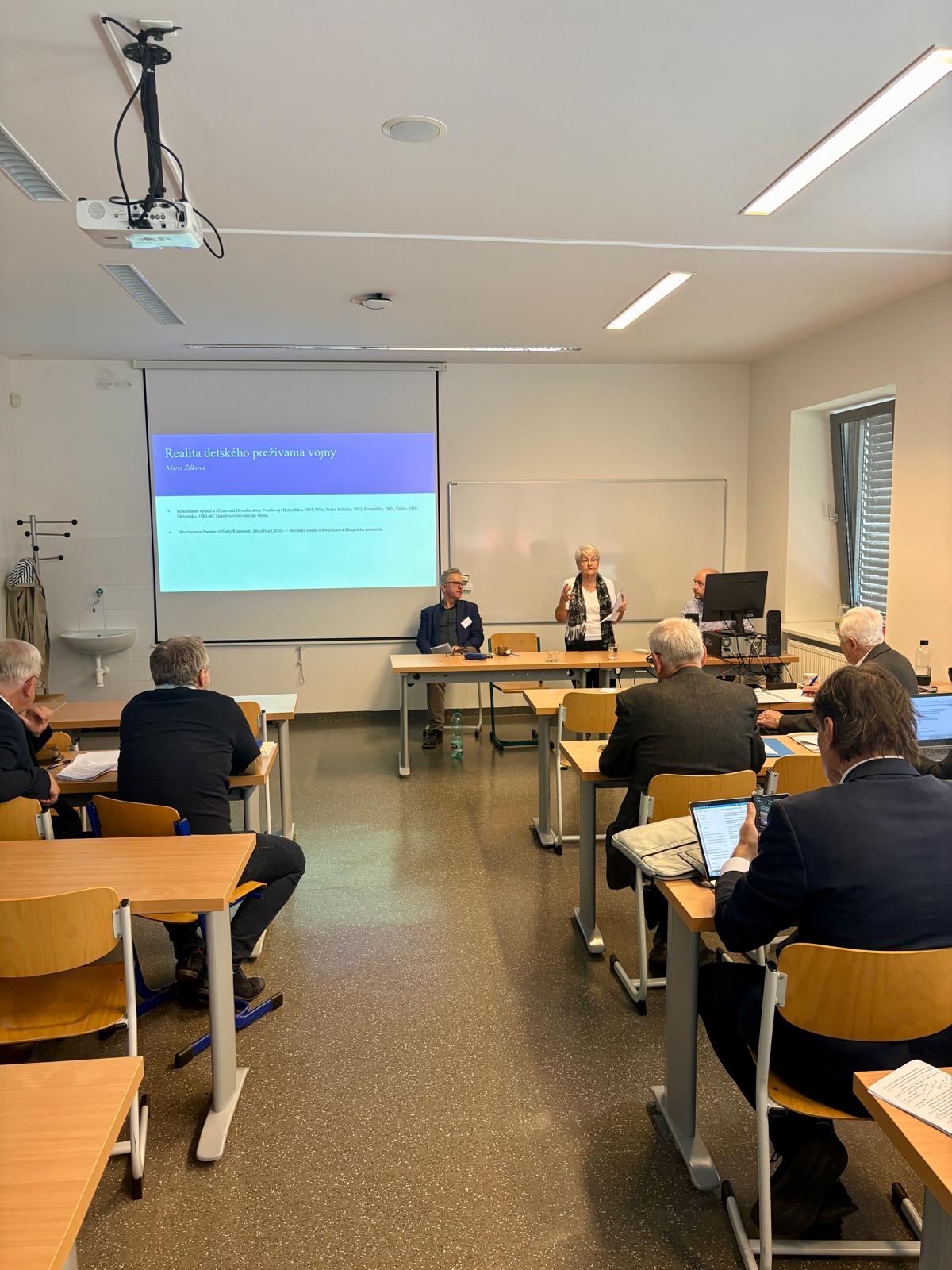
Marta Žilková reflected on the figure of the child in war stories, pointing to differences in its portrayal depending on the perspective of the attacking or defending side of the conflict. She focused in particular on the emotional dimension of the child’s experience, dominated by fear that takes various forms – from an immediate threat to life and the fear of losing loved ones to the uncertainty caused by the collapse of a familiar world. She also discussed the transformation of family and social roles, when the circumstances of war force children to grow up prematurely, take responsibility for others and often find themselves in a position that would normally belong to adults. This reversal of roles reveals a fundamental disruption of the child’s world as well as differences in how war is experienced and artistically conveyed. The figure of the child thus becomes not only the bearer of an emotionally powerful testimony, but also allows insight into the wider social and moral consequences of war conflicts.
Beata Kozieł compared the ways of constructing the image of a geopolitical threat and of the enemy in interwar literature and in today’s digital media. Using specific examples, she traced the mechanisms of stereotyping, creating the image of the “other” and shaping collective attitudes. Her comparison also raised the question of the persistence of certain ways of depicting the enemy which, despite different historical and communication conditions, are still applied in today’s media discourse.
Zdeněk Brdek discussed the narrative strategies used by contemporary Czech authors in depicting the war in Ukraine in literature for children and young people. He paid particular attention to the ways war events are conveyed to young readers and to the importance of the narrative perspective in bringing closer experiences that go beyond their immediate world.
The final afternoon block broadened the thematic scope of the conference with further perspectives. Through an analysis of selected documentary films, Štefan Timko focused on the representation of Russian society, examining how documentary production captures social attitudes and value orientations. Vladimír Heger approached the issue of war from a different perspective, focusing on its symbolic meanings and layers of meaning, which change depending on the historical, social and cultural context.
Regardless of how it is depicted in literature, film or the media, war nevertheless remains linked to the experience of violence, suffering, dehumanisation and existential threat. It was precisely these dimensions, present in several conference presentations, that highlighted the need for critical reflection on war conflicts, their causes and consequences. The academic environment provides space not only for examining the ways war is represented, but also for discussing the mechanisms that contribute to the emergence and persistence of hostility, stereotypes and social division. Such reflection is also relevant in the educational process, which is why the interest of students in the conference was encouraging.
The expert programme was complemented by the exhibition Fake News, located in the foyer of the Faculty of Central European Studies and on loan from the Czech Centre in Bratislava. Thematically, it followed up on the issues of media manipulation, disinformation and the creation of distorted images of social reality. It thus reminded visitors that the struggle over the interpretation of events is also part of war conflicts, and that the ability to approach information critically takes on particular importance in this context.
The following day, 16 October 2026, the event continued at the Czech Centre in Bratislava, where participants were welcomed by its director Monika Koblerová. The programme included a screening of the historical biographical film Milan Rastislav Štefánik (1935) directed by Jan Sviták. The choice of the film was not accidental. As Miloš Zelenka and Štefan Timko noted before the screening, Štefánik, as one of the key figures in the founding of Czechoslovakia, is an important symbol of shared Czech-Slovak history and still holds a prominent place in social memory, as evidenced by his victory in the Greatest Slovak poll in 2019. His efforts towards Czechoslovak unity and cooperation between the two nations are of particular significance in this context. The film is also a rare feature-length biographical adaptation of Štefánik’s life. It is interesting not only for its historical subject, but also for its cast of Czech and Slovak actors and its use of both languages. The screening thus followed up on the Czech-Slovak focus of the conference and provided further food for thought on the cinematic representation of historical events and personalities.
The two days of expert meetings showed that the different forms of literary, film and media depictions of war raise questions that go beyond the boundaries of individual academic disciplines. Examining them makes it possible not only to name problems and uncover their historical, social and cultural contexts, but also to gain a deeper understanding of the experiences that individuals and entire communities are still coming to terms with today. The organisers therefore believe that in the coming years, in cooperation with domestic and international partners, it will be possible to continue the academic discussion on topics that, despite being rooted in history, remain urgently relevant.
Text: doc. PhDr. Zuzana Vargová, PhD., FCES – Institute of Central European Languages and Cultures
Photo: Mgr. Dominika Hlavinová Tekeliová, PhD., FCES – Institute of Central European Languages and Cultures