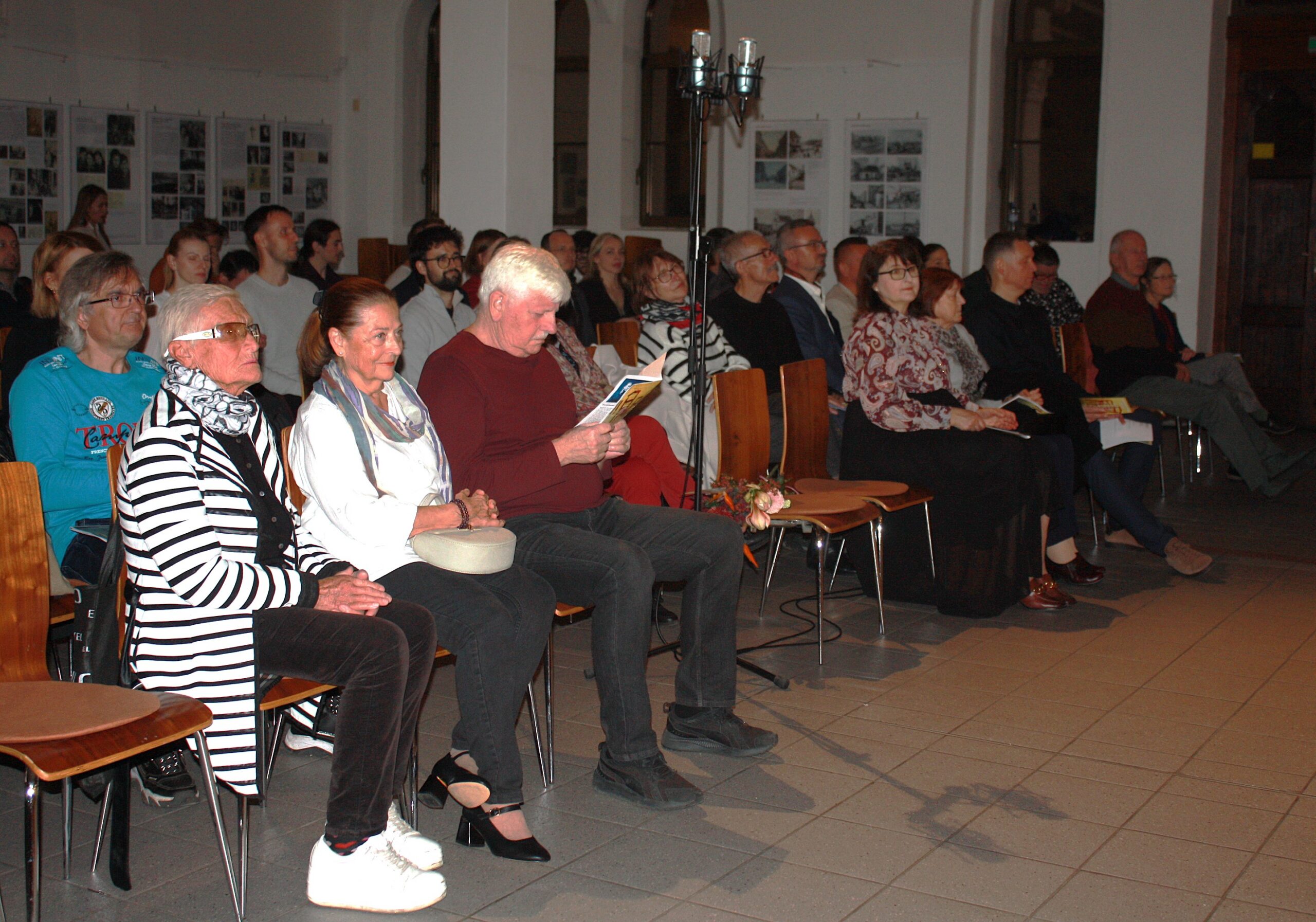
The spaces of the Nitra Synagogue came alive with various forms of art – visual, musical, compositional, and interpretative – from October 26 to 30, 2026. The 23rd edition of the Confrontations 2026 Arts Festival offered visitors an exhibition of artworks by Lucia Huňady Kubalová, which opened the festival on October 26, along with a series of five evening concerts. The opening of the exhibition featuring works by D. Martinček was enhanced by guitarist Karol Kompas.
The festival was organized by the NGO Confrontations in collaboration with the Faculty of Education at UKF in Nitra, supported by public sources from partners such as the City of Nitra, the Nitra Self-Governing Region, the Slovak Copyright Protection Association, the Music Fund, and also supported by civic associations Andante and Ja a My. The festival was under the patronage of the Dean of the Faculty of Education at UKF in Nitra, doc. PaedDr. Gábor Pintes, PhD.
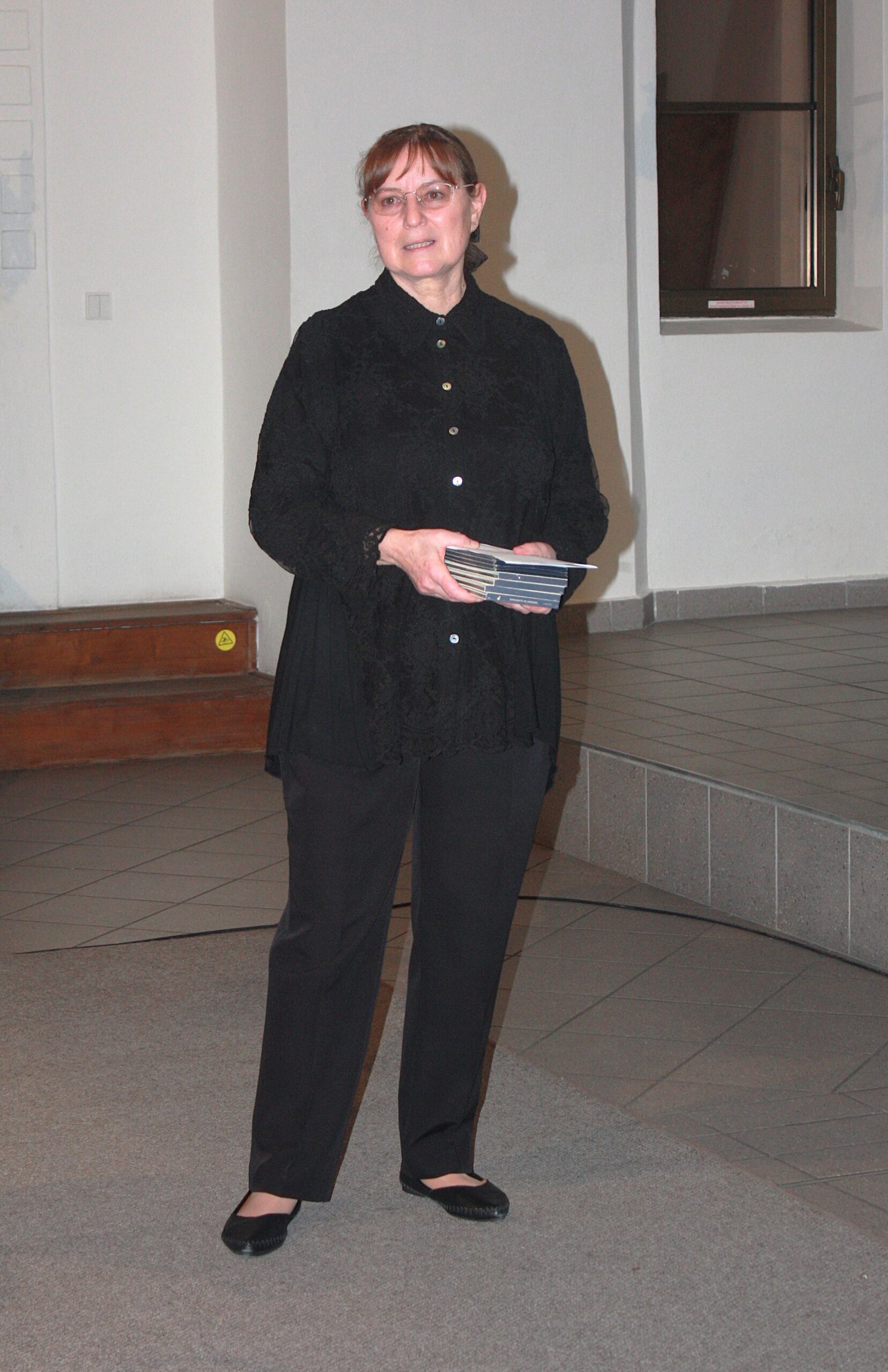
Participants at the event in the Synagogue were welcomed by the festival’s dramaturge, Mgr. Alena Čierna, PhD., and the exhibition curator, doc. PhDr. Adriana Récka, PhD., university professor. According to Dr. Alena Čierna, head of the Department of Music at the Faculty of Education at UKF in Nitra, they aimed to compile the event’s dramaturgy to represent both the past and the present, so that the festival would appeal to listeners with contemporary Slovak creations as well as significant works of world music literature performed by both our and foreign interpreters.
“The festival offered many pieces by contemporary Slovak composers, whether it is J. Iršai, Ľ. Bernáth, J. Kmiťová, or O. Kroupová. On one hand, we have concerts that reflect contemporary Slovak creation and Slovak interpretative art, while on the other hand, there are concerts that are distinctly romantic in character, for example, a concert featuring works by F. Liszt, which is an exclusive artistic experience, as Liszt’s works are rarely played in such a complex. These are not purely virtuosic, brilliant pieces that are usually part of concerts, but rather contemplative, thought-provoking compositions, and in this way, we aim to present the work of this composer anew,” Dr. Alena Čierna explained.
“The event thus brought together connections of history and the present, as well as connections of young art and renowned art, because for example, Peter Mikuláš, a native of Nitra, accepted the invitation to the festival, where he joyfully sings – specifically contemporary works by J. Iršai and L. Holoubek.”
There was no Slovak premiere at the festival, but according to the dramaturge, the event offered listeners exceptional works that are rarely heard at concerts, such as children’s pieces by J. Iršai, which combine complex compositional techniques with a playful childlike principle.
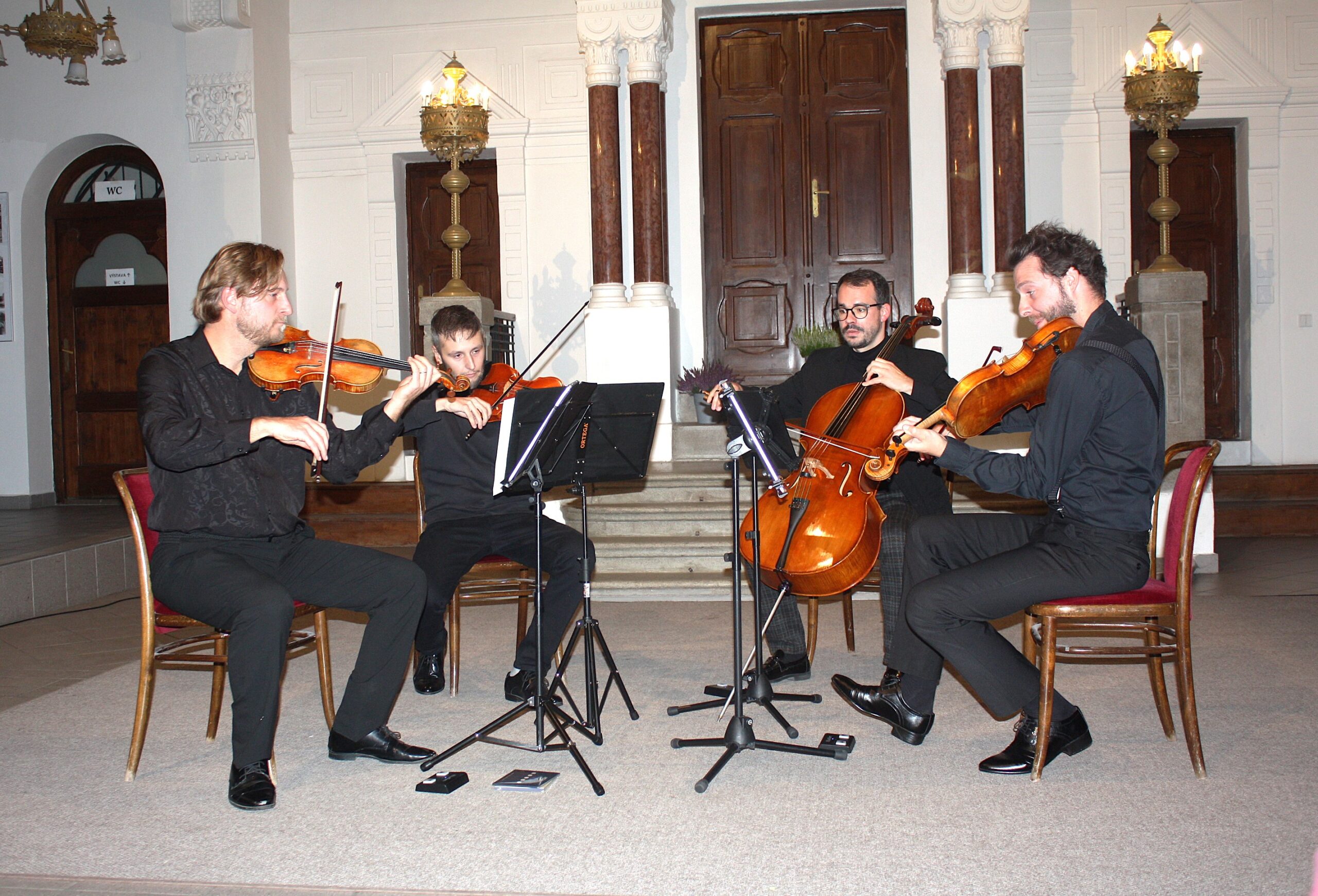
After the opening of the exhibition of Lucia Huňady Kubalová’s works, the concert hall of the Synagogue belonged to the first concert of the festival on October 26. The Spectrum Quartett, featuring interpreters J. Kružliak, M. Vilhan (both violins), P. Dvorský (viola), and B. Bielik (cello), presented works by S. Prokofiev, Ľ. Čekovská, Ľ. Bernáth, and J. Iršai. A recital dedicated to the lyrical works of F. Liszt was presented on October 27 by pianist D. Šašinová Satury. The works of Slovak composers J. Kmiťová, O. Kroupová, I. Szeghy, and M. Jašurdová were introduced on October 28 by a vocal recital of mezzo-soprano A. Pietrová and pianist Z. Manera Biščáková. The stage belonged on the evening of October 29 to Nitra native, bassist P. Mikuláš, and pianist and composer J. Iršai. The concluding piano recital on October 30 showcased the interpretative art of J. Jiraský from the Czech Republic, who presented works by R. Schumann, F. Chopin, B. Smetana, L. Janáček, and G. Gershwin.
Text and photo: Ing. Jana Černáková, R – Media Department